
Day 30: 30 Juzz, 30 Habits
Surah al-Fajr
Jannah is a gift, but belonging to Allah is the true victory
فَٱدْخُلِى فِى عِبَـٰدِى وَٱدْخُلِى جَنَّتِى
So join My servants, and enter My Paradise.
(Surah al-Fajr 89:29–30 – Sahih International)
Surah al-Fajr gives us one of the most comforting endings for a believer. After a life of patience, struggle, and quiet faith, Allah welcomes the soul with honor.
Before the believer is invited into Jannah, Allah first says: “Enter among My servants.” This shows that real success is being counted among the sincere servants of Allah—those who obeyed Him in private, trusted Him during hardship, and returned to Him again and again.
Being claimed by Allah as His servant is the greatest honor a person can receive. Jannah is the gift, but belonging to Allah is the true victory.
Jannah is the destination,
but being Allah’s servant is the identity.
Habit – 30
Renewed my niyyah to live as a true servant of Allah.
A sincere heart,
a life lived for His pleasure,
and hope for the final welcome from our Lord.

Day 29: 30 Juzz, 30 Habits

Surah al-Insān (also called ad-Dahr)
Real generosity is giving what you love
وَيُطْعِمُونَ ٱلطَّعَامَ عَلَىٰ حُبِّهِۦ مِسْكِينًا وَيَتِيمًا وَأَسِيرًا
And they give food—despite their love for it—to the poor, the orphan, and the captive.
(Surah al-Insān 76:8 – Sahih International)
Surah al-Insān shows us a beautiful example of generosity. These believers give food even while they themselves still desire it. Their giving is not from extra wealth or leftovers, but from something they value.
This kind of charity reflects a heart that trusts Allah more than what it holds in its hands. By feeding the poor, the orphan, and even the captive, they honor the dignity of those who are often forgotten.
Such generosity purifies the soul from selfishness and teaches us that love for Allah should be reflected in how we treat His creation.
Real generosity is giving what you love,
not only what you no longer need.
Habit – 29
Set aside a small weekly amount to feed someone in need this Ramadān.
A giving hand,
a trusting heart,
and kindness shared for the sake of Allah.

Day 28: 30 Juzz, 30 Habits

Surah aṣ-Ṣaff
Dā‘wah loses its weight when our lives don’t match our words
يَـٰٓأَيُّهَا ٱلَّذِينَ ءَامَنُوا۟ لِمَ تَقُولُونَ مَا لَا تَفْعَلُونَ
O believers! Why do you say what you do not do?
(Sūrah aṣ-Ṣaff 61:2 – Sahih International)
Surah aṣ-Ṣaff reminds us that Allah calls the believers to honesty between their words and their actions. Islam is not only about speaking what is right; it is about striving to live by it.
When our words move faster than our actions, trust weakens and reminders lose their weight. But when we try to practice what we speak about, even imperfectly, our words begin to carry sincerity and influence.
This āyah invites us to pause and look inward before we advise others. The goal is not perfection, but honest effort to align our speech with our actions.
Allah does not ask for perfection,
but He does ask for honesty and effort.
Habit – 28
Held myself accountable and checked if I’m living what I say.
An honest heart,
a sincere effort,
and words that grow from actions.
Day 27: 30 Juzz, 30 Habits

Surah Qāf
You are never alone: Allah is nearer than your own vein
وَنَحْنُ أَقْرَبُ إِلَيْهِ مِنْ حَبْلِ ٱلْوَرِيدِ
And We are closer to him than ˹his˺ jugular vein.
(Surah Qāf 50:16 – Sahih International)
Surah Qāf reminds us of the incredible closeness of Allah to His servants. He knows every thought, every worry, and every quiet feeling hidden in our hearts.
Nothing we experience is unknown to Him—our fears, our hopes, and even the struggles we cannot put into words. Often we feel pressure to appear strong in front of people, but with Allah there is no need to pretend. He already knows the story behind our tears, the reason for our silence, and the intentions behind every action we take.
When a believer understands this closeness, the heart finds comfort. We begin to speak to Allah more honestly, turning to Him in every moment of ease and difficulty.
Remember: no tear, no whisper, and no hope in your heart is ever unnoticed by Allah.
Habit – 27
Reminded myself that Allah sees my thoughts before my actions.
A mindful heart,
a sincere intention,
and awareness of Allah’s closeness in every moment.
Day 26: 30 Juzz, 30 Habits

Surah Muḥammad
True connection requires reflection, not just recitation
أَفَلَا يَتَدَبَّرُونَ ٱلْقُرْءَانَ أَمْ عَلَىٰ قُلُوبٍ أَقْفَالُهَآ
Do they not then reflect upon the Qur’an? Or are there locks upon their hearts?
(Surah Muḥammad 47:24 – Sahih International)
Surah Muḥammad calls us to pause and truly reflect on the words of Allah. The Qur’an was not revealed only to be recited, but to be understood, contemplated, and lived.
When we rush through the āyāt without reflection, the message remains outside the heart, like someone standing at the door of a house without entering it. Allah asks whether the hearts are locked, reminding us that distractions, sins, and neglect can slowly seal the heart from receiving guidance.
But when we slow down and reflect, the Qur’an begins to soften the heart. It corrects our intentions, reshapes our character, and brings clarity to our lives.
Let the āyāt challenge you, comfort you, and guide you toward becoming better.
Habit – 26
Made a plan to recite one page of Qur’an every day until Ramadān and reflect on its lessons.
A page read with reflection,
a heart open to guidance,
and the Qur’an slowly shaping the soul.

Day 25: 30 Juzz, 30 Habits

Surah Al-Ahqaf
Every gentle word to your parents is a step closer to Jannah
وَوَصَّيْنَا الْإِنسَانَ بِوَالِدَيْهِ إِحْسَانًا
And We have enjoined upon man goodness to his parents.
(Surah Al-Ahqaf 46:15 – Sahih International)
Surah Al-Ahqaf reminds us that honoring our parents is not optional; it is a command from Allah. Kindness toward them is a path to His pleasure.
Our parents carried us through weakness, worry, and sacrifice. Even if they were not perfect, they are the means Allah chose for our existence. Speaking gently, showing patience, and making dua for them are acts of worship that bring us closer to Allah.
Honor begins in the heart,
and shows itself in gentle words and sincere dua.
Habit – 25
Made the dua for my parents:
رَّبِّ ارْحَمْهُمَا كَمَا رَبَّيَانِي صَغِيرًا
A grateful heart,
a softened tone,
and mercy asked from the Most Merciful.
Day 24: 30 Juzz, 30 Habits
Surah Ghafir (Al-Mu’min)
Duʿa is an essential and intimate form of worship
ٱدْعُونِىٓ أَسْتَجِبْ لَكُمْ
Call upon Me; I will respond to you.
(Surah Ghafir 40:60 – Sahih International)
Surah Ghafir reminds us that duʿa is not a last resort; it is worship itself. Allah invites us to call upon Him with the promise of response.
Nothing we whisper is ignored. Every sincere duʿa is heard. Sometimes the answer comes immediately, sometimes it is saved for the Hereafter, and sometimes it protects us from harm we never see.
Before Ramadan arrives,
begin turning to Allah consistently.
Habit – 24
Made the duʿa:
يَا حَيُّ يَا قَيُّومُ بِرَحْمَتِكَ أَسْتَغِيثُ
A whispered plea,
a dependent heart,
and trust in Allah’s promise to respond.

Day 23: 30 Juzz, 30 Habits
Surah As-Saffat
Ask not just for children, but for righteous hearts close to Allah
رَبِّ هَبْ لِي مِنَ الصَّالِحِينَ
My Lord, grant me [a child] from among the righteous.
(Surah As-Saffat 37:100 – Sahih International)
Surah As-Saffat teaches us what truly matters in our dua. Ibrahim عليه السلام did not simply ask for a child; he asked for righteousness. He understood that what lasts beyond this world is not numbers or names, but hearts that are close to Allah.
Righteousness is a gift from Allah. It is something we ask for with humility, for ourselves and for those we love. What continues after us is not wealth, but sincere dua and good deeds carried forward.
Ask not just to receive,
but to be made pleasing to Allah.
Habit – 23
Made the dua:
رَبِّ هَبْ لِي مِنَ الصَّالِحِينَ
for myself and my family today.
A hopeful prayer,
a sincere request,
and trust in Allah’s gift of righteousness.


Day 21: 30 Juzz, 30 habits

Surah Al-Ankabut
The strongest shield is a sincere salah
إِنَّ الصَّلَاةَ تَنْهَىٰ عَنِ الْفَحْشَاءِ وَالْمُنكَرِ
Indeed, prayer prohibits immorality and wrongdoing.
(Surah Al-Ankabut 29:45 – Sahih International)
Surah Al-Ankabut reminds us that salah is not only an obligation; it is protection. When offered with sincerity and presence, it becomes a shield between us and what harms our souls.
Allah teaches us that genuine prayer slowly draws the heart away from indecency and sin. Even if change feels gradual, every sincere sajdah reshapes the heart from within.
Salah steadies the soul,
and guides it back to purity.
Habit – 21
Prayed every salah with awareness
that it is a shield from sins and a light for the Hereafter.
A mindful prayer,
a guarded heart,
and a return to Allah’s protection.

Day 20: 30 Juzz, 30 habits
Surah Al-Furqan
Be careful who you let into the deepest circle of your heart
يَا وَيْلَتَىٰ لَيْتَنِي لَمْ أَتَّخِذْ فُلَانًا خَلِيلًا
Oh, woe to me! I wish I had not taken that one as a close friend.
(Surah Al-Furqan 25:28 – Sahih International)
Surah Al-Furqan reminds us that companionship shapes faith. The Qur’an separates truth from falsehood, and it also reveals how the wrong influence can pull a heart away from guidance.
On the Day of Judgment, some will regret the friendships they chose over obedience to Allah. Not every close friend in this world will be worth remembering in the next.
The people you keep close
either strengthen your faith or slowly weaken it.
Habit – 20
Left one group or conversation
that regularly pulls my heart away from Allah.
A guarded heart,
a wiser choice,
and companionship chosen for the sake of Allah.

Day 19: 30 Juzz, 30 Habits

Surah An-Nur
Leave their wrong with Allah, and seek His mercy for your own
وَلْيَعْفُوا وَلْيَصْفَحُوا أَلَا تُحِبُّونَ أَن يَغْفِرَ اللَّهُ لَكُمْ
Let them pardon and overlook. Would you not love for Allah to forgive you?
(Surah An-Nur 24:22 – Sahih International)
Surah An-Nur reminds us that forgiveness is not weakness, but worship. When Abu Bakr رضي الله عنه was deeply hurt, Allah guided him to rise above his pain and forgive for the sake of Allah.
This ayah invites us to clear resentment from the heart and turn the page with sincerity. We forgive not because the hurt was small, but because we hope for something greater — Allah’s forgiveness for us.
When you release what they did,
Allah heals what it did to you.
Habit – 19
Chose to forgive someone for the sake of Allah,
seeking His mercy for myself.
A released burden,
a softened heart,
and hope in Allah’s forgiveness.

Day 18: 30 Juzz, 30 Habits
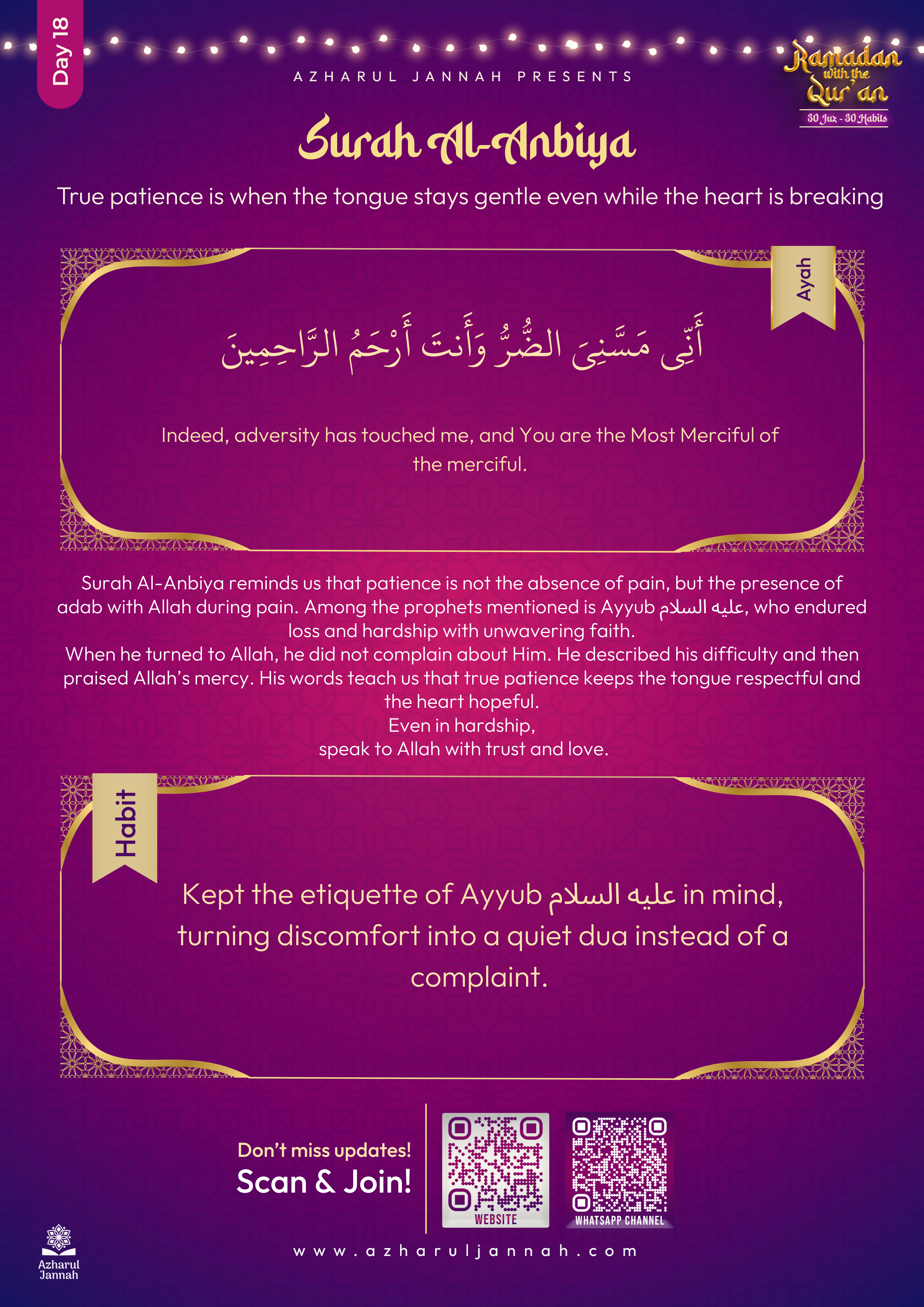
Surah Al-Anbiya
True patience is when the tongue stays gentle even while the heart is breaking
أَنِّي مَسَّنِيَ الضُّرُّ وَأَنتَ أَرْحَمُ الرَّاحِمِينَ
Indeed, adversity has touched me, and You are the Most Merciful of the merciful.
(Surah Al-Anbiya 21:83 – Sahih International)
Surah Al-Anbiya reminds us that patience is not the absence of pain, but the presence of adab with Allah during pain. Among the prophets mentioned is Ayyub عليه السلام, who endured loss and hardship with unwavering faith.
When he turned to Allah, he did not complain about Him. He described his difficulty and then praised Allah’s mercy. His words teach us that true patience keeps the tongue respectful and the heart hopeful.
Even in hardship,
speak to Allah with trust and love.
Habit – 18
Kept the etiquette of Ayyub عليه السلام in mind,
turning discomfort into a quiet dua instead of a complaint.
A gentle tongue,
a patient heart,
and hope placed in Allah’s mercy.

Day 17: 30 Juzz, 30 Habits

Surah Maryam
Be people of the Qur’an, and hold on to it with strength
يَا يَحْيَىٰ خُذِ الْكِتَابَ بِقُوَّةٍ
“O Yahya, hold firmly to the Scripture.”
(Surah Maryam 19:12 – Sahih International)
Surah Maryam reminds us that true growth comes from holding tightly to the Book of Allah. In the midst of stories filled with emotion and mercy, Allah commands Yahya عليه السلام to take the Scripture with strength.
This command is for every believer. Holding the Qur’an with strength means allowing it to shape our choices, guide our character, and discipline our habits. It means choosing the Qur’an over distraction and returning to it even when we feel tired.
Real transformation begins
when the Qur’an leads the heart.

Day 16: 30 Juzz, 30 Habits

Surah Al-Kahf
Return to Tawhid. Renew your intention. Realign your heart
فَمَن كَانَ يَرْجُوا لِقَاءَ رَبِّهِ فَلْيَعْمَلْ عَمَلًا صَالِحًا وَلَا يُشْرِكْ بِعِبَادَةِ رَبِّهِ أَحَدًا
So whoever hopes for the meeting with his Lord, let him do righteous work and not associate anyone in the worship of his Lord.
(Surah Al-Kahf 18:110 – Sahih International)
Surah Al-Kahf closes with a reminder that hope in meeting Allah must show itself in action. Faith is not only felt; it is practiced through sincerity and pure worship.
This ayah calls us back to Tawhid — to worship Allah alone, without showing off, without distraction, and without seeking approval from others. It invites us to examine our intentions and realign them quietly with what pleases Him.
Hope for the meeting with Allah
begins with sincere deeds done for Him alone.
Habit – 16
Recited the best dhikr today:
لَا إِلَهَ إِلَّا اللَّهُ
A renewed intention,
a heart anchored in Tawhid,
and remembrance centered on Allah alone.

Day 15: 30 Juzz, 30 Habits
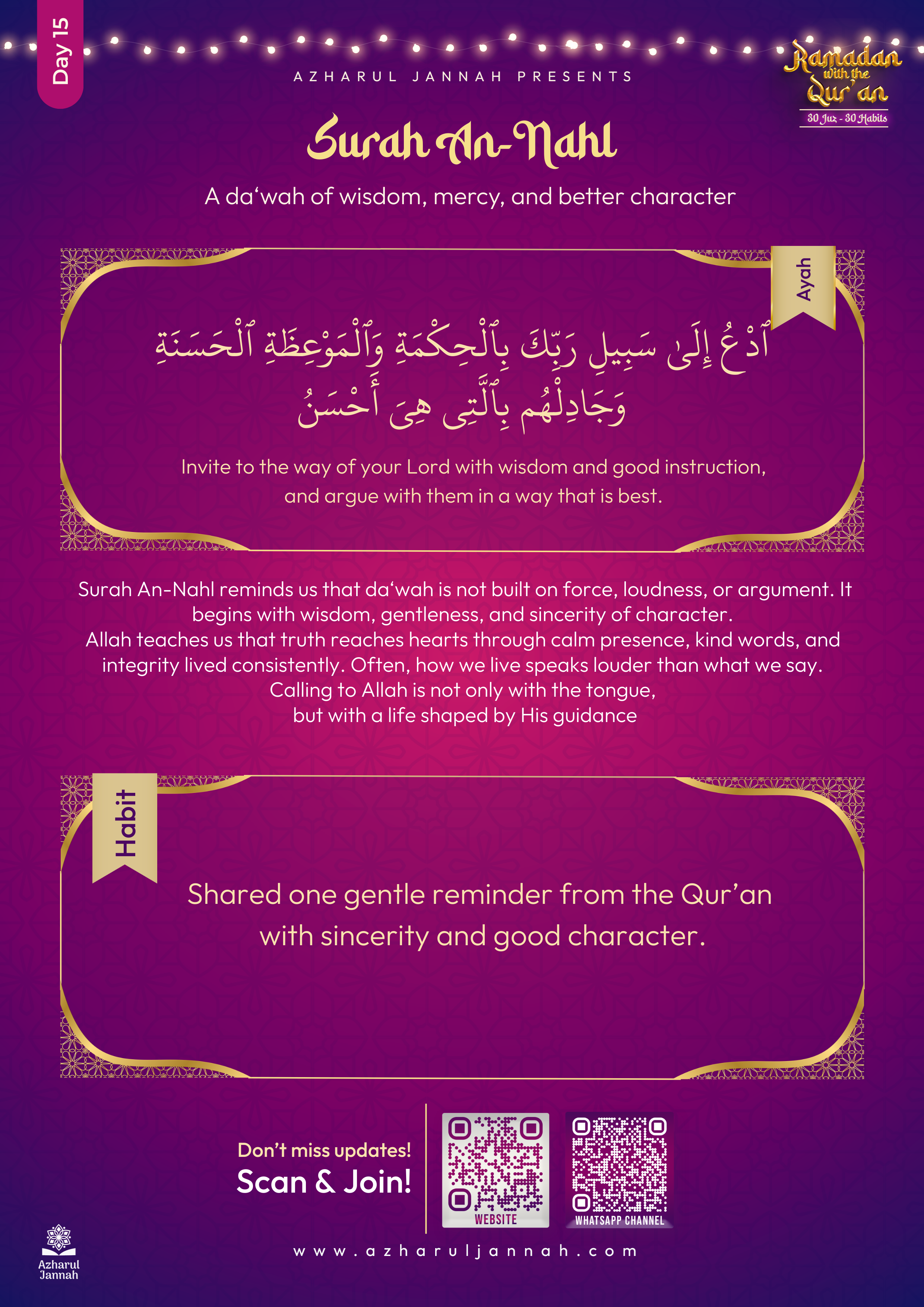
Surah An-Nahl
A da‘wah of wisdom, mercy, and better character
ٱدْعُ إِلَىٰ سَبِيلِ رَبِّكَ بِٱلْحِكْمَةِ وَٱلْمَوْعِظَةِ ٱلْحَسَنَةِ وَجَادِلْهُم بِٱلَّتِي هِيَ أَحْسَنُ
Invite to the way of your Lord with wisdom and good instruction, and argue with them in a way that is best.
(Surah An-Nahl 16:125 – Sahih International)
Surah An-Nahl reminds us that da‘wah is not built on force, loudness, or argument. It begins with wisdom, gentleness, and sincerity of character.
Allah teaches us that truth reaches hearts through calm presence, kind words, and integrity lived consistently. Often, how we live speaks louder than what we say.
Calling to Allah is not only with the tongue,
but with a life shaped by His guidance.
Habit – 15
Shared one gentle reminder from the Qur’an
with sincerity and good character.
A soft word,
a thoughtful moment,
and da‘wah practiced through wisdom.

Day 14: 30 Juzz, 30 Habits

Surah Al-Hijr
The Qur’an you read today is a gift Allah Himself preserved
إِنَّا نَحْنُ نَزَّلْنَا الذِّكْرَ وَإِنَّا لَهُ لَحَافِظُونَ
Indeed, it is We who sent down the Reminder, and indeed, We will be its Guardian.
(Surah Al-Hijr 15:9 – Sahih International)
Surah Al-Hijr reminds us that the Qur’an is not a human effort or historical accident. Allah Himself revealed it, and Allah Himself preserves it.
This preservation is not limited to pages and ink. It lives through hearts that remember and tongues that recite. Every believer who connects with even a single ayah becomes part of this divine protection.
The more you hold onto the Qur’an,
the more it holds onto you.
Habit – 14
Made niyyah to join the protection Allah promised
by memorizing the Qur’an, even if it is one ayah.
A sincere intention,
a lasting commitment,
and a place within Allah’s preserved trust.

Day 13: 30 Juzz, 30 Habits
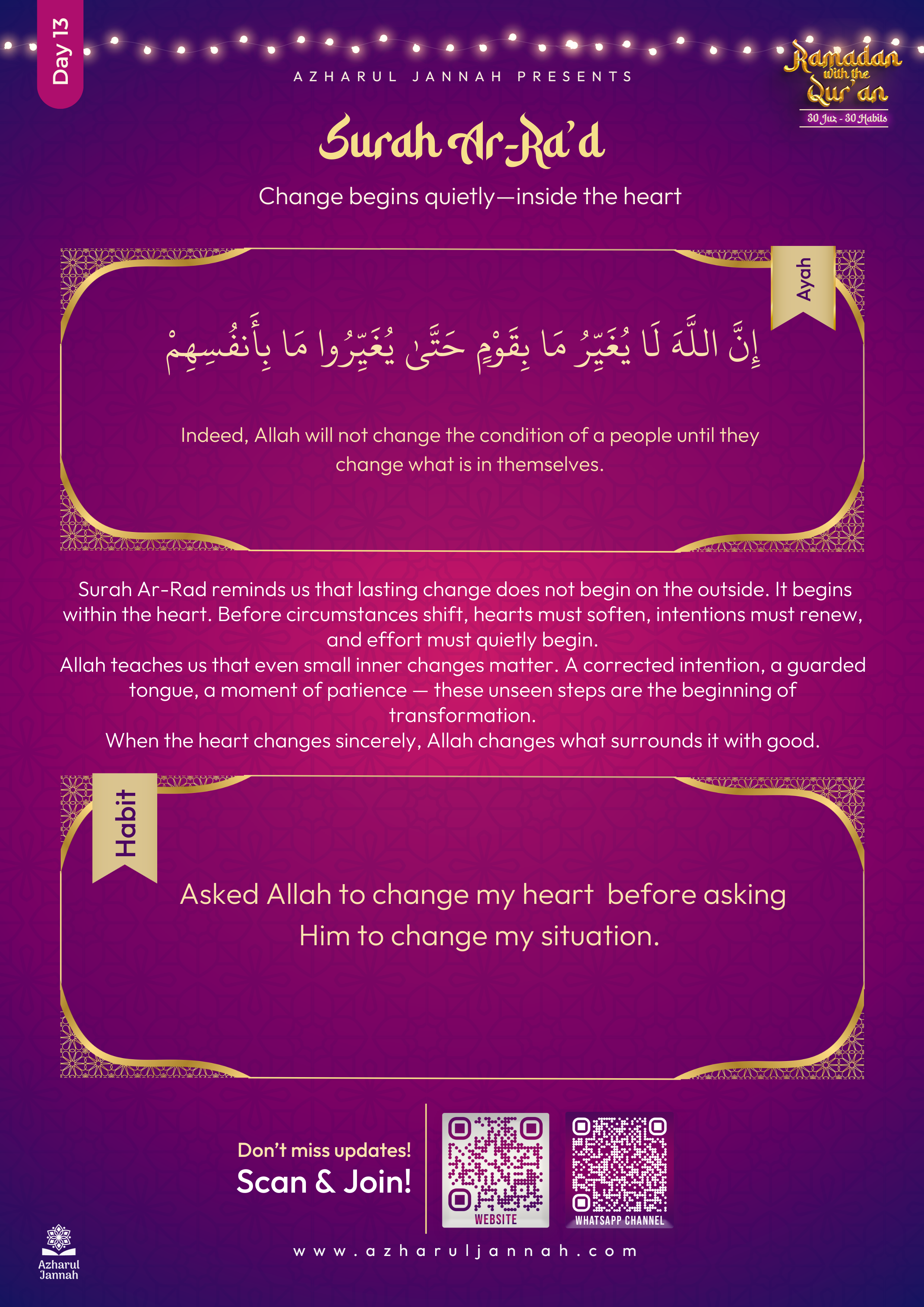
Surah Ar-Rad
Change begins quietly—inside the heart
إِنَّ اللَّهَ لَا يُغَيِّرُ مَا بِقَوْمٍ حَتَّىٰ يُغَيِّرُوا مَا بِأَنفُسِهِمْ
Indeed, Allah will not change the condition of a people until they change what is in themselves.
(Surah Ar-Rad 13:11 – Sahih International)
Surah Ar-Rad reminds us that lasting change does not begin on the outside. It begins within the heart. Before circumstances shift, hearts must soften, intentions must renew, and effort must quietly begin.
Allah teaches us that even small inner changes matter. A corrected intention, a guarded tongue, a moment of patience — these unseen steps are the beginning of transformation.
When the heart changes sincerely,
Allah changes what surrounds it with good.
Habit – 13
Asked Allah to change my heart
before asking Him to change my situation.
A sincere dua,
an inward shift,
and trust placed in Allah’s wisdom.
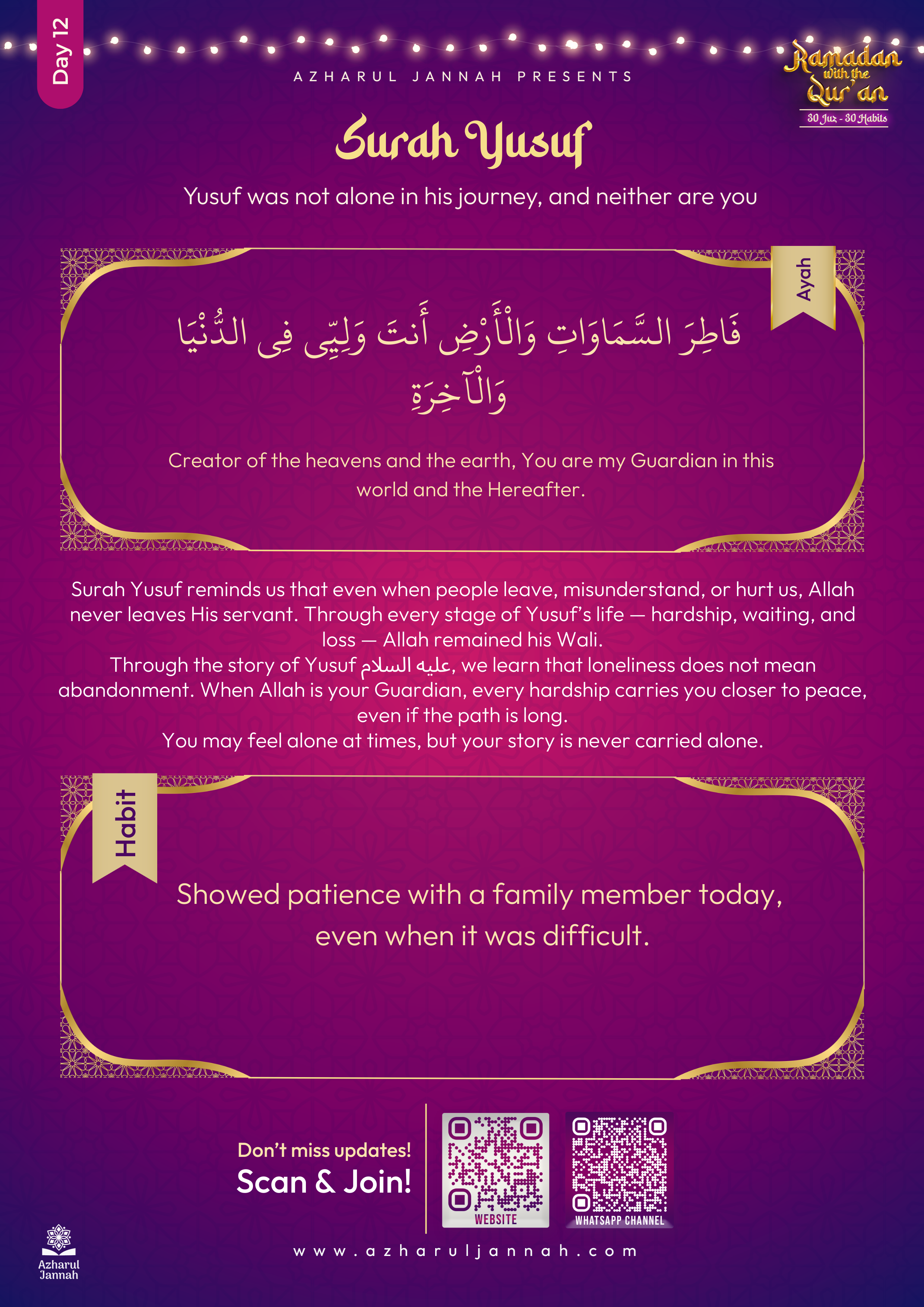
Day 12: 30 Juzz, 30 Habits
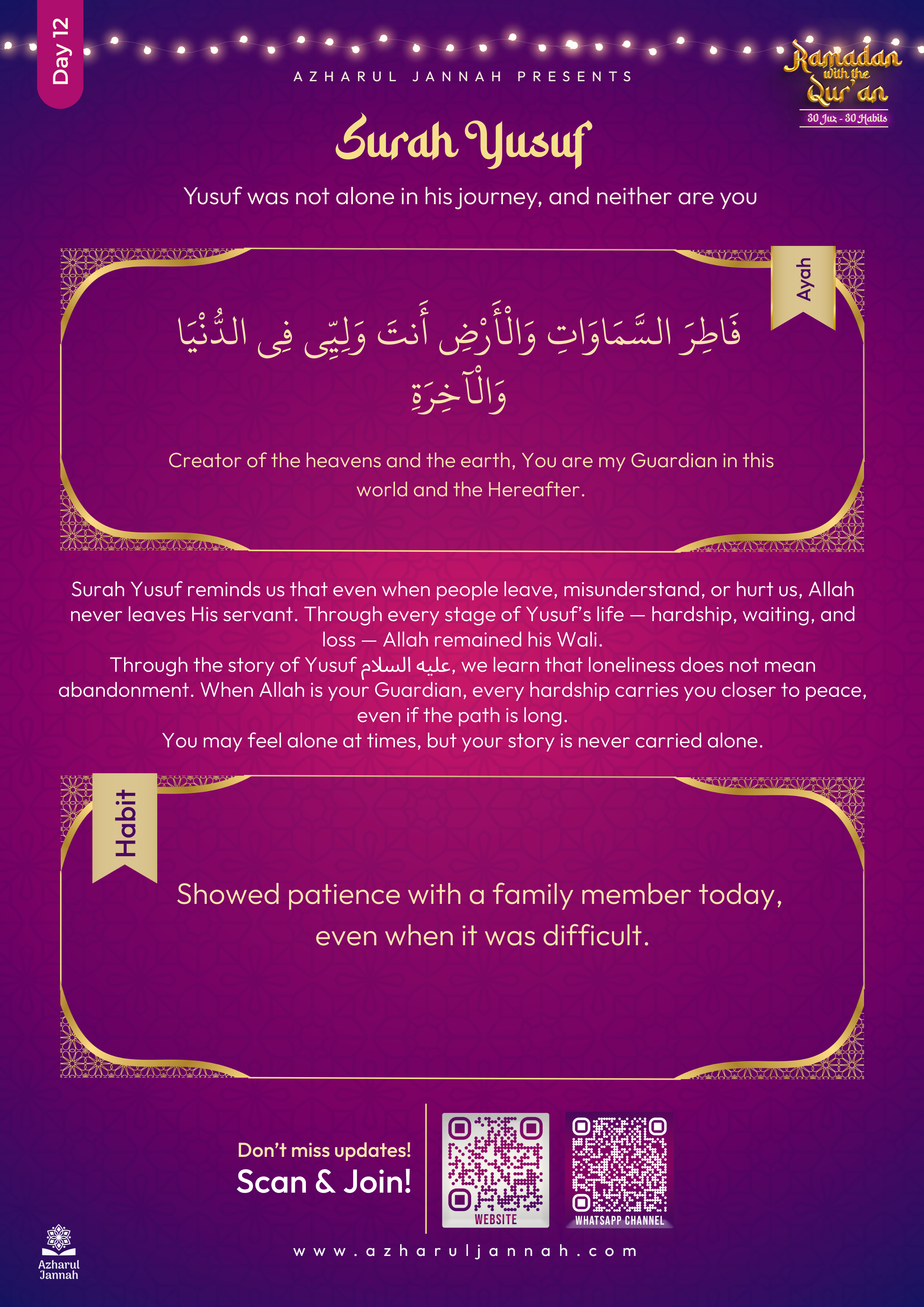
Surah Yusuf
Yusuf was not alone in his journey, and neither are you
فَاطِرَ السَّمَاوَاتِ وَالْأَرْضِ أَنتَ وَلِيِّي فِي الدُّنْيَا وَالْآخِرَةِ
Creator of the heavens and the earth, You are my Guardian in this world and the Hereafter.
(Surah Yusuf 12:101 – Sahih International)
Surah Yusuf reminds us that even when people leave, misunderstand, or hurt us, Allah never leaves His servant. Through every stage of Yusuf’s life — hardship, waiting, and loss — Allah remained his Wali.
Through the story of Yusuf عليه السلام, we learn that loneliness does not mean abandonment. When Allah is your Guardian, every hardship carries you closer to peace, even if the path is long.
You may feel alone at times,
but your story is never carried alone.
Habit – 12
Showed patience with a family member today,
even when it was difficult.
A restrained response,
a trusting heart,
and reliance placed in Allah as my Wali.
Day 11: 30 Juzz, 30 Habits
Surah Hud
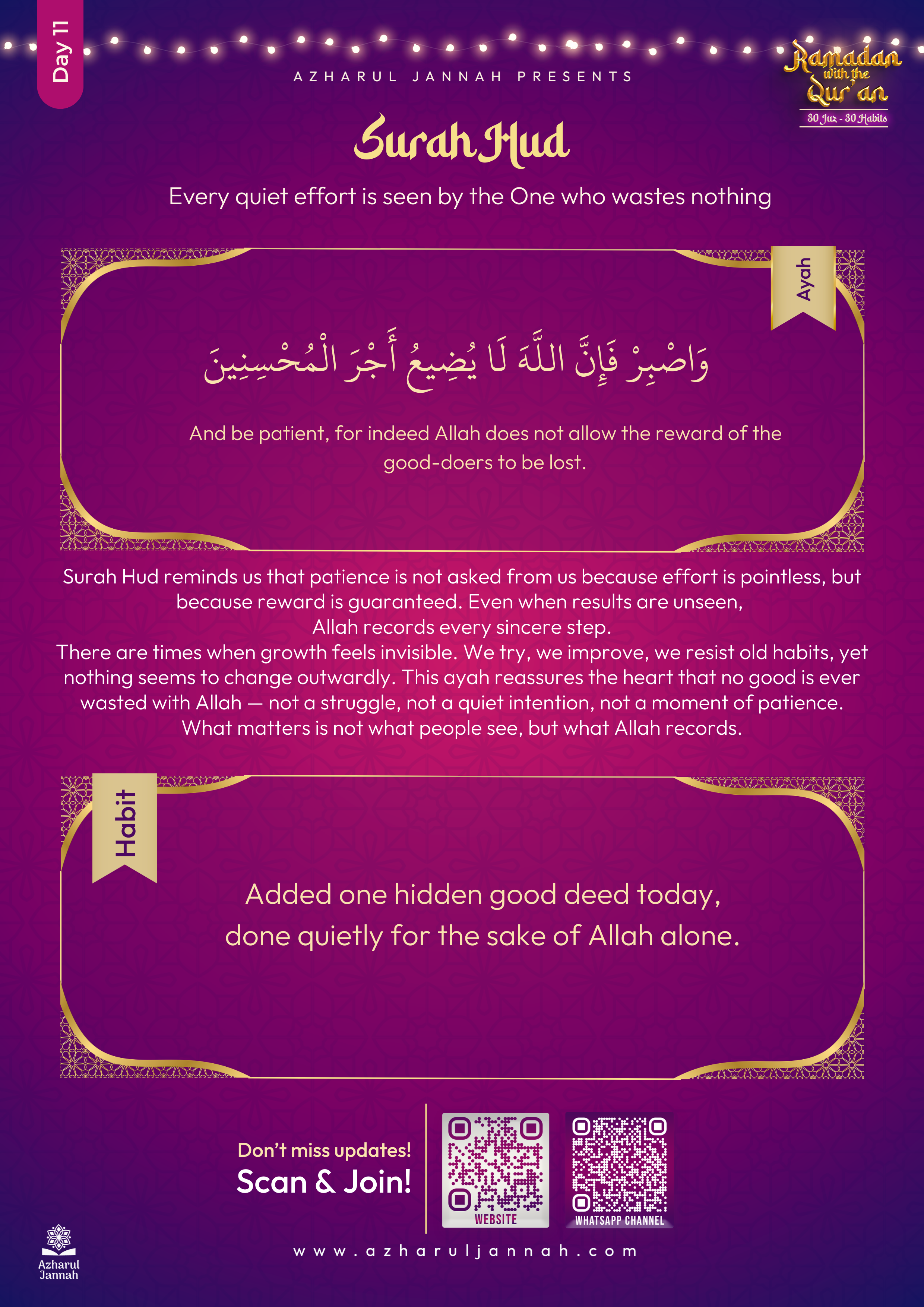
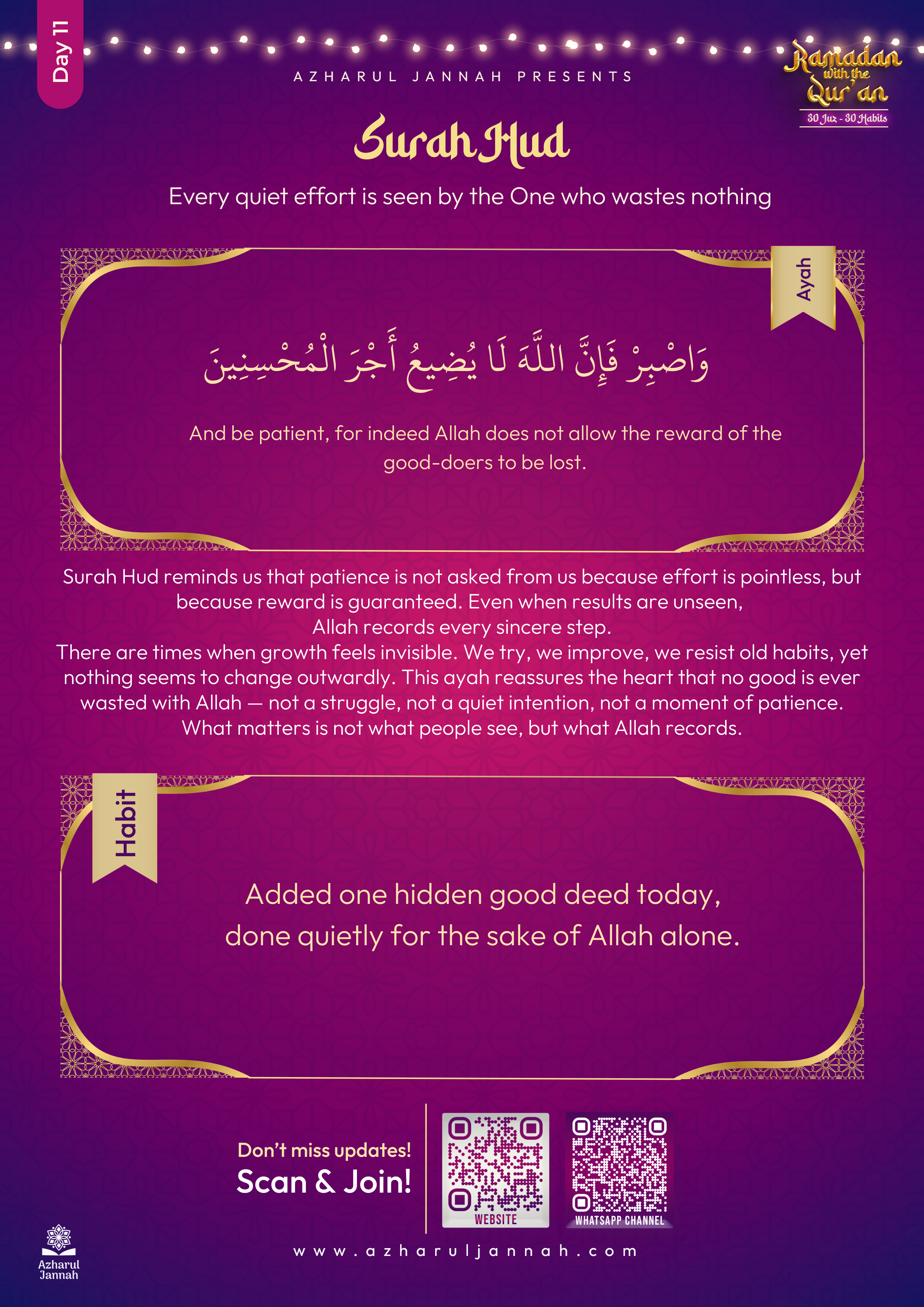
Every quiet effort is seen by the One who wastes nothing
وَاصْبِرْ فَإِنَّ اللَّهَ لَا يُضِيعُ أَجْرَ الْمُحْسِنِينَ
And be patient, for indeed Allah does not allow the reward of the good-doers to be lost.
(Surah Hud 11:115 – Sahih International)
Surah Hud reminds us that patience is not asked from us because effort is pointless, but because reward is guaranteed. Even when results are unseen, Allah records every sincere step.
There are times when growth feels invisible. We try, we improve, we resist old habits, yet nothing seems to change outwardly. This ayah reassures the heart that no good is ever wasted with Allah — not a struggle, not a quiet intention, not a moment of patience.
What matters is not what people see,
but what Allah records.
Habit – 11
Added one hidden good deed today,
done quietly for the sake of Allah alone.
A sincere effort,
a patient heart,
and trust in Allah’s perfect record.